
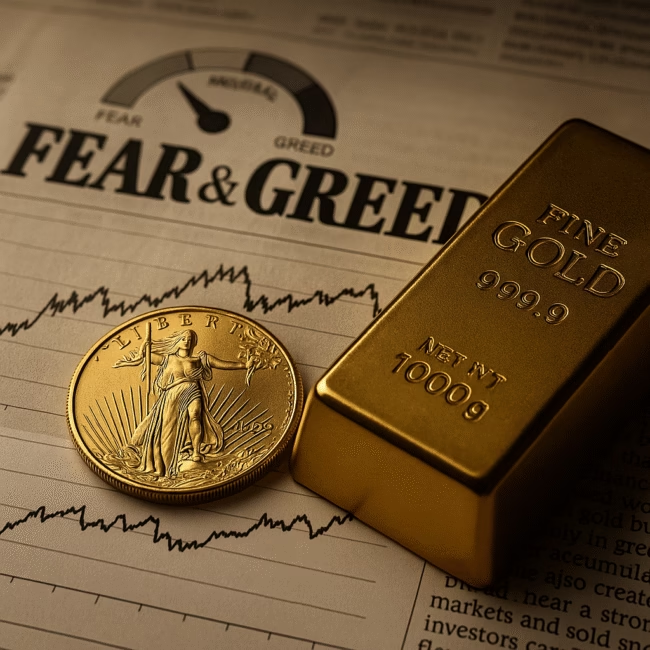
Investor psychology shapes financial markets more than most professionals admit. While models and data point in one direction, human emotions frequently push prices somewhere else entirely. Understanding the relationship between market sentiment and gold has become essential for investors trying to separate signal from noise in volatile markets.
Originally created by CNN Money, the Fear and Greed Index measures overall market sentiment using seven key indicators. The question it attempts to answer is straightforward: Are investors more afraid right now—or more greedy? For gold investors, this matters because sentiment extremes often coincide with significant price movements in precious metals.
What the Fear and Greed Index Measures
The index combines seven components into a single sentiment reading that ranges from 0 (Extreme Fear) to 100 (Extreme Greed). Each component captures a different aspect of market behavior:
| Component | What It Measures | Potential Impact on Gold |
|---|---|---|
| Stock Momentum | S&P 500 vs. 125-day moving average | Strong momentum often reduces safe-haven demand |
| Stock Price Strength | Stocks at 52-week highs vs. lows | More highs may signal reduced gold interest |
| Market Breadth | Volume of advancing vs. declining stocks | Weak breadth can trigger gold buying |
| Put/Call Ratio | Bearish vs. bullish options bets | High put buying often correlates with hedge demand |
| Safe Haven Demand | Bond demand vs. stocks | Bond flight typically supports gold |
| Volatility (VIX) | Expected S&P 500 volatility | High VIX often coincides with gold inflows |
| Junk Bond Demand | Appetite for risky debt | Low demand may signal risk-off environment |
What makes this sentiment indicator valuable is that it consolidates multiple data points into a single, easy-to-monitor signal.
Important note: A 2024 academic study published in ScienceDirect found that while the Fear and Greed Index shows predictive power for equity returns, the direct statistical relationship with gold returns at the daily level is less consistent. This suggests the index works better as a contextual tool rather than a precise timing mechanism.
Why Fear Episodes Often Lift Gold Prices
Fear is one of the strongest forces in financial markets, and the connection between sentiment extremes and gold becomes most visible during panic episodes. When investors abandon risk assets, they don’t just move to cash—they seek stores of value that have survived previous crises.
Safe-Haven Demand During Market Stress
Gold’s appeal during fear spikes stems from a simple reality: its value doesn’t depend on corporate earnings, government promises, or central bank credibility. When stocks plunge or geopolitical headlines turn threatening, gold becomes a refuge because it exists outside the traditional financial system.
Historical data demonstrates consistent patterns:
- 2008 Financial Crisis: Gold rose 25% while the S&P 500 declined 37%. After initially falling during the liquidity crisis, gold surged from around $700 to nearly $1,900 per ounce by September 2011.
- 2020 Pandemic: Gold gained 25% for the year, reaching then-record levels above $2,000 per ounce by August, even after experiencing sharp short-term drops during the March liquidity squeeze.
- 2022-2025 Period: Despite aggressive interest rate hikes, gold showed resilience during recurring geopolitical tensions, supported by sustained central bank purchasing.
These patterns reflect rational investor behavior during uncertainty—capital flows toward assets perceived to preserve purchasing power across crises.
Liquidity Preference in Panic
During extreme fear episodes, investors favor assets they can trust implicitly or hold physically. Gold fits both criteria. Unlike bonds that depend on issuer solvency or stocks that require functioning markets, gold maintains value even when financial infrastructure strains.
This explains why the sentiment-gold connection strengthens during systemic stress. It’s not just about returns—it’s about confidence that an asset will retain value when everything else is uncertain.
How Greed Phases Affect Gold—And Create Opportunities
When the index pushes above 80 (Extreme Greed), capital typically flows toward higher-beta assets: technology stocks, cryptocurrencies, high-yield bonds, and speculative plays. Gold sometimes experiences short-term pullbacks during these periods as investors chase momentum.
But sentiment patterns reveal something important: greed periods often precede corrections. Extreme sentiment readings have historically been followed by mean reversion—what goes up in euphoria often comes down when reality sets in.
Why Greed Can Be a Contrarian Signal
Experienced gold investors treat greed extremes as accumulation opportunities rather than reasons to exit. The logic:
- Extreme greed reflects widespread complacency about risk
- Momentum-driven rallies frequently reverse when sentiment shifts
- Gold tends to rally once greed collapses back into fear
- Buying during greed periods means acquiring gold at relative discounts
This contrarian approach requires discipline. When markets are euphoric, suggesting gold accumulation sounds pessimistic. But sentiment extremes rarely persist—and reversals can be swift.
Gold Market Context for 2025
Several factors make sentiment analysis especially relevant in the current environment:
Central Bank Accumulation
According to the World Gold Council’s 2025 survey, central banks have accumulated over 1,000 tonnes of gold in each of the last three years—roughly double the 400-500 tonne average from the preceding decade. In their latest survey, 95% of central bank respondents expect global official gold reserves to increase over the next 12 months.
This institutional demand provides a structural floor under gold prices that individual investor sentiment cannot override.
Geopolitical Uncertainty
Regional conflicts and trade tensions keep baseline uncertainty elevated, supporting safe-haven flows even when equity markets perform well. This creates support for gold prices that pure technical analysis might miss.
Interest Rate Environment
Central bank policy remains a key variable. Fear about recession risks competes with expectations about potential rate adjustments—creating volatility that has historically correlated with gold price movements.
Using Sentiment Data in Practice
Understanding the relationship intellectually differs from applying it practically. Here’s how experienced investors approach sentiment analysis:
Monitor Changes, Not Just Absolute Levels
A move from 50 to 30 matters more than whether the reading is 30 or 35. Rapid sentiment shifts signal increasing fear that often precedes gold rallies. The velocity of sentiment change can be more informative than static readings.
Combine Sentiment with Technical Analysis
Sentiment data works best when paired with price analysis. If gold is testing support while fear is rising, that’s a stronger signal than fear rising while gold trades at resistance. Context matters.
Use Sentiment Extremes to Plan Position Sizing
Some traders scale positions based on sentiment extremes:
| Index Range | Interpretation | Potential Approach |
|---|---|---|
| 0-20 (Extreme Fear) | Maximum pessimism | Consider increasing exposure |
| 20-40 (Fear) | Elevated caution | Maintain positions |
| 40-60 (Neutral) | No strong signal | Hold; wait for clarity |
| 60-80 (Greed) | Growing complacency | Consider gradual accumulation |
| 80-100 (Extreme Greed) | Maximum optimism | Strong accumulation opportunity |
This approach treats sentiment as a timing tool within a longer-term allocation strategy, not as a reason to abandon gold exposure entirely.
Limitations of Sentiment Indicators
The Fear and Greed Index is useful but not omniscient. It cannot predict:
- Duration of extremes: Fear can persist for months or reverse in days
- Magnitude of moves: Similar fear readings produce different gold price responses
- Fundamental shifts: Central bank policy changes can override sentiment
- Black swan events: Unexpected crises often precede sentiment changes, not follow them
The index measures current psychology, not future events. It’s most useful as a confirmation tool—supporting decisions based on fundamental analysis rather than replacing that analysis entirely.
Integrating Sentiment Into Your Strategy
Most successful gold investors treat sentiment as one input among several:
- Daily monitoring: Check the index alongside gold prices. Note when sentiment and price diverge—these anomalies often precede reversals.
- Correlation awareness: Track how your portfolio responds to sentiment shifts over time. You’ll develop intuition for when correlations strengthen or weaken.
- Extreme alerts: Pay special attention to readings below 20 or above 80. These extremes warrant attention even if you don’t adjust positions.
- Fundamental alignment: Sentiment matters most when aligned with fundamentals. Fear during inflation concerns carries different weight than fear during stable economic periods.
Key Takeaways
The relationship between market sentiment and gold won’t predict every market twist, but it reveals how investors feel—and those emotions shape gold demand more than many acknowledge.
Understanding this relationship isn’t about forecasting the future. It’s about recognizing when psychology aligns with opportunity—especially for an asset with gold’s historical track record during uncertainty.
For investors building positions, sentiment extremes offer potential entry points that pure technical or fundamental analysis might miss. The challenge isn’t reading the data—it’s acting on it when everyone else is doing the opposite.
Sources
- CNN Business – Fear and Greed Index
- World Gold Council – Central Bank Gold Reserves Survey 2025
- ScienceDirect – The CNN Fear and Greed Index as a predictor of US equity index returns (2024)
- JM Bullion – History of Gold Prices
- Visual Capitalist – Gold’s Annual Returns 2000-2025
Disclaimer: This article is for educational purposes only and does not constitute financial advice. Past performance does not guarantee future results. Consult a licensed financial advisor before making investment decisions.