
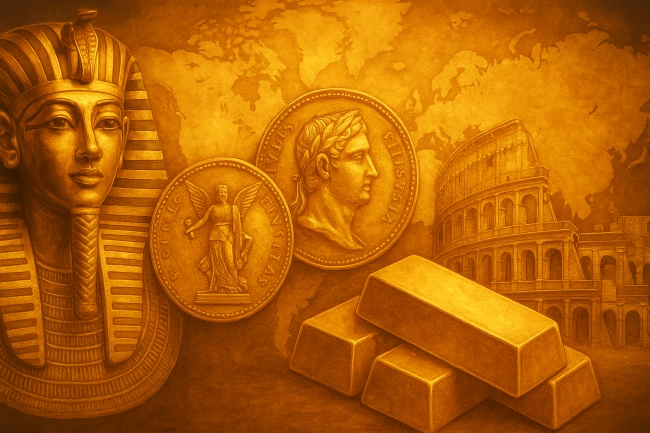
Gold History: From Ancient Civilizations to Modern Economies
Gold history spans over 5,000 years of human civilization, during which this remarkable metal has served as currency, store of wealth, religious symbol, and marker of power. From sacred rituals in ancient temples to modern central bank vaults, gold history reveals how a single element has profoundly influenced economic systems, political structures, and cultural values across millennia.
Understanding gold history helps investors contextualize contemporary gold markets within broader patterns of human behavior around scarcity, value, and trust. The forces that made gold central to ancient Egyptian funerary practices—durability, scarcity, aesthetic appeal—remain relevant when evaluating why central banks continue accumulating gold in 2025. Tracking how gold history influences current market dynamics through resources like our live gold price chart connects past patterns to present opportunities.
The Timeless Role of Gold in Human Civilization
Gold history demonstrates that this metal has consistently transcended purely economic functions to serve deeper psychological and social purposes. Throughout recorded history, gold has represented divinity and royalty in religious and political systems, driven exploration and conquest as civilizations sought new sources, anchored trade routes and currencies as commerce expanded, and influenced policy and global ambition as nations competed for reserves.
According to archaeological research documented by the British Museum, evidence of gold working dates to at least 4000 BCE in Eastern Europe, with sophisticated goldsmithing techniques appearing in Egypt, Mesopotamia, and the Indus Valley by 3000 BCE. This early adoption across geographically separated civilizations suggests gold’s appeal emerged independently multiple times—a testament to properties that humans universally valued.
Gold in Ancient Civilizations
Early gold history reveals how ancient societies integrated this metal into religious, political, and economic structures that established patterns persisting for millennia.
Egypt and Mesopotamia: The First Gold Cultures
Around 2600 BCE, ancient Egyptians were using gold extensively in tombs, temples, and royal regalia. Gold symbolized eternity and divine power—appropriate for a civilization obsessed with permanence and the afterlife. The famous gold mask of Tutankhamun, dating to approximately 1323 BCE, represents perhaps the most iconic artifact in gold history, demonstrating both technical sophistication and the metal’s association with kingship.
Egyptian gold history shows organized mining operations in Nubia (modern Sudan) that supplied vast quantities of gold for pharaonic projects. Temple inscriptions and papyri document gold as payment for labor, tribute from conquered territories, and diplomatic gifts between kingdoms—establishing gold’s role in multiple economic and political contexts.
Mesopotamian civilizations including Sumerians, Akkadians, and Babylonians used gold in ceremonial objects, religious structures, and royal offerings. The Royal Graves of Ur (circa 2600 BCE) contained elaborate gold artifacts demonstrating advanced metallurgical techniques. Unlike Egypt where gold was relatively abundant, Mesopotamian gold history reflects scarcity that made the metal even more precious and exclusive to elite classes.
Ancient China and India
Gold history in Asia developed somewhat independently but reached similar conclusions about gold’s value. Chinese civilizations used gold for decorative purposes, currency, and markers of status from at least 1100 BCE during the Shang Dynasty. However, China’s preference for jade and silk in certain contexts meant gold never dominated Chinese culture as completely as it did in Mediterranean civilizations.
India’s gold history extends back to the Indus Valley Civilization (3300-1300 BCE), with gold jewelry and artifacts appearing in archaeological sites. The Rigveda, composed around 1500 BCE, mentions gold (hiranya) in contexts suggesting it was already valuable and associated with wealth and divine radiance. Indian demand for gold—both for jewelry and religious purposes—would become a major force in global gold markets continuing to present day.
Gold in Classical Empires
As civilizations expanded into empires, gold history entered a phase where the metal became fundamental to monetary systems and international trade.
Rome: Standardizing Gold Currency
Roman gold history begins with adoption of gold coinage around 3rd century BCE, though silver dominated Roman currency for centuries. Julius Caesar’s monetary reforms increased gold’s role, but the aureus—introduced by Augustus around 27 BCE—truly standardized gold coinage across the Roman Empire.
According to historical research from Cambridge University, the aureus maintained remarkable stability for nearly 200 years, containing approximately 7.3 grams of gold. This standardization created trust in transactions across the vast empire, demonstrating gold’s utility as universal medium of exchange where language, customs, and legal systems varied dramatically.
Roman taxation systems increasingly relied on gold as the empire expanded. Citizens in distant provinces paid taxes partly in gold, which funded military operations, infrastructure projects, and imperial administration. This centralization of gold flows to Rome exemplified how gold history intertwines with political power—control over gold sources and circulation became synonymous with imperial authority.
Byzantine Solidus: Medieval Gold Standard
After Rome’s division, the Byzantine solidus (introduced by Constantine I around 312 CE) became perhaps the most successful gold coin in history. For over 700 years, the solidus maintained consistent weight and purity—approximately 4.5 grams of pure gold—creating a currency trusted from Britain to India.
Byzantine gold history shows how monetary stability can outlast political institutions. Even as the Western Roman Empire collapsed, the solidus remained the dominant currency for international trade throughout the Mediterranean and beyond. Merchants knew exactly what a solidus was worth anywhere they traveled—a level of monetary certainty that wouldn’t be replicated until modern gold standards.
Gold and Global Trade Routes
Medieval and early modern gold history is inseparable from the expansion of trade networks that connected distant civilizations.
The Silk Road and Gold Flows
Gold played a critical role in Silk Road commerce from roughly 200 BCE to 1400 CE, linking Europe and the Middle East with India, China, and Central Asia. According to research published by Nature, gold coins from Rome, Byzantium, Persia, and India have been found along Silk Road routes, demonstrating the metal’s role as universal currency.
This phase of gold history reveals an important pattern: even civilizations that didn’t value gold equally internally recognized it as medium of exchange in international trade. Chinese merchants might prefer silk and porcelain domestically, but they accepted gold from foreign traders because they knew gold retained value across borders.
African Gold and Mediterranean Trade
West African gold from kingdoms including Ghana, Mali, and Songhai profoundly impacted European and Islamic gold history from roughly 700 CE to 1600 CE. Mansa Musa’s legendary hajj to Mecca in 1324 CE—during which his gold distribution temporarily destabilized Cairo’s economy—demonstrated the enormous wealth concentrated in West African gold-producing regions.
Trans-Saharan trade routes carrying West African gold north sustained Mediterranean civilizations and Islamic empires for centuries. This gold financed European economic development during periods when European gold production was minimal, showing how gold history involves complex international flows rather than purely domestic sources.
The Age of Exploration and Gold
European gold history took dramatic turn during the Age of Exploration (15th-17th centuries) when the search for gold became primary motivation for transoceanic voyages.
Spanish Conquest and American Gold
Spanish conquest of the Americas represented one of the most consequential chapters in gold history. Between 1500 and 1800, an estimated 150,000 to 180,000 tons of gold and silver flowed from the Americas to Europe, fundamentally altering European economies and global power balances.
The Potosí silver mine in modern Bolivia, along with gold from Mexico and Peru, financed Spanish Habsburg ambitions for centuries. However, this influx also contributed to inflation throughout Europe—a phenomenon known as the „Price Revolution“—demonstrating that gold’s value depends partly on scarcity. When supply increases dramatically, purchasing power declines.
The Gold Standard Era
Modern gold history is dominated by the gold standard period (roughly 1870-1971) when major economies tied currency values directly to gold.
Classical Gold Standard (1870-1914)
According to monetary historians, the classical gold standard represented the first truly international monetary system. Major economies including Britain, Germany, France, and the United States fixed their currencies to specific gold amounts, creating stable exchange rates that facilitated international trade and investment.
Under the gold standard, governments promised to exchange currency for gold at fixed rates. This limited money supply growth and provided automatic stabilization mechanisms—countries losing gold due to trade deficits experienced deflation that made exports cheaper, eventually reversing gold outflows. This phase of gold history showed gold functioning as international monetary anchor rather than just commodity or store of value.
Interwar Instability and Gold
World War I suspended the gold standard as nations printed money to finance military operations. Attempts to restore gold convertibility in the 1920s failed to recreate pre-war stability. Britain’s return to gold in 1925 at an overvalued exchange rate contributed to economic stagnation. The Great Depression ultimately forced most countries to abandon gold convertibility by the mid-1930s.
This turbulent period in gold history revealed limitations of rigid gold standards during economic crises. When deflation struck, inability to expand money supply exacerbated recessions. The flexibility that modern central banks take for granted didn’t exist under strict gold convertibility.
Bretton Woods: Gold’s Last Monetary Stand
In 1944, the Bretton Woods agreement established a modified gold standard where currencies were pegged to the U.S. dollar, which remained convertible to gold at $35 per ounce. This system made gold the foundation of post-war international monetary stability while giving the United States unique privileges as issuer of the reserve currency.
According to research from International Monetary Fund historians, Bretton Woods worked reasonably well until the 1960s when U.S. gold reserves declined as dollars accumulated overseas. Other countries could theoretically exchange dollars for gold, creating pressure on U.S. reserves that eventually became unsustainable.
The Nixon Shock (1971)
On August 15, 1971, President Richard Nixon ended dollar convertibility to gold—a decision that collapsed the Bretton Woods system and ended gold’s formal monetary role. This pivotal moment in gold history freed currency exchange rates to float, redefined gold as strategic reserve and inflation hedge rather than money, and initiated the modern era where gold competes with currencies rather than backing them.
The Nixon Shock didn’t end gold’s importance—it transformed it. Freed from fixed price controls, gold prices rose from $35 per ounce in 1971 to over $800 by 1980, demonstrating enormous pent-up demand that fixed prices had suppressed.
Gold in Contemporary Economy
Modern gold history (1971-present) shows the metal retaining significance despite losing formal monetary status.
Central Bank Reserves
Despite abandoning the gold standard, central banks globally hold approximately 35,000 tons of gold—roughly 20% of all gold ever mined. This gold history paradox—why hold gold if it’s not money?—reflects ongoing belief in gold as ultimate reserve asset during crises.
Recent trends show emerging market central banks increasing gold reserves while developed economies maintain substantial holdings. This continues gold history’s pattern of gravitating toward power centers, though now driven by diversification and hedging rather than monetary backing.
Investment Demand
Investment demand represents a relatively recent chapter in gold history. Gold ETFs, which emerged in 2003, made gold investment accessible to ordinary investors rather than only institutions and the wealthy. This democratization has grown investment demand from negligible levels in the 1970s to major market force today.
For investors building modern portfolios that incorporate lessons from gold history, tools like our portfolio investment calculator help model how gold allocations perform under various economic scenarios that echo past crises and booms.
Technology and Industrial Use
Contemporary gold history includes growing industrial applications in electronics, medicine, and aerospace—uses impossible in ancient times but enabled by modern technology. While jewelry and investment still dominate demand, industrial applications create baseline consumption that didn’t exist historically. For investors evaluating physical gold purchases, resources like our gold carat calculator help verify purity and value.
Lessons From Gold History
Reviewing 5,000 years of gold history reveals patterns relevant for contemporary investors and policymakers:
Gold Transcends Individual Civilizations
Empires rise and fall, but gold persists. Egyptian, Roman, and Byzantine gold still exists and retains value. This permanence distinguishes gold from paper currencies, corporate equity, or government bonds—all dependent on continuing institutions.
Scarcity Creates Value
Gold history shows that when supply floods markets (Spanish Americas, California Gold Rush), prices decline. When supply is constrained, prices rise. This scarcity—approximately 205,000 tons ever mined with annual production under 3,500 tons—underpins gold’s value proposition.
Trust Matters More Than Technology
Byzantine solidus maintained value for 700 years despite political instability because people trusted its weight and purity. Modern fiat currencies can fail despite sophisticated central banking if trust evaporates. Gold history suggests trust built over millennia provides stability that new systems lack.
Monetary Gold and Investment Gold Coexist
Even after 1971, gold retains quasi-monetary status through central bank reserves while functioning as investment asset and industrial commodity. This dual nature—not quite money, not quite commodity—makes gold unique in financial markets.
Conclusion: Gold History as Ongoing Story
Gold history isn’t a closed chapter ending in 1971—it’s an ongoing narrative where ancient patterns continue influencing modern markets. The same properties that made gold sacred to Egyptians—durability, beauty, scarcity—drive central banks to hold reserves today. The universal recognition that enabled gold to facilitate Silk Road trade operates when investors worldwide buy gold during crises.
Understanding gold history provides perspective that short-term market analysis lacks. When investors panic during a correction and gold rallies, they’re participating in a pattern thousands of years old—flight to tangible assets during uncertainty. When central banks diversify reserves away from pure dollar holdings, they’re following logic established when Byzantine merchants held solidus alongside local currencies.
For investors navigating 2025’s complex markets, gold history offers both caution and reassurance. Caution: gold doesn’t guarantee wealth—Spanish gold influx caused inflation, not prosperity. Reassurance: gold’s 5,000-year track record of value retention exceeds any fiat currency, corporation, or government.
The question for contemporary investors isn’t whether gold has historical significance—that’s undeniable. It’s whether gold history’s patterns will continue influencing future markets. Given human psychology’s consistency across millennia and gold’s unique physical properties, betting against gold’s continued relevance seems more risky than embracing it.
Further Reading
- British Museum – Ancient Gold Collections
- Cambridge University – Monetary History Research
- Nature – Archaeological Gold Studies
- International Monetary Fund – Bretton Woods History
- World Gold Council – Modern Gold Markets
- Live Gold Price Chart
Disclaimer: The information provided in this article is for general informational and educational purposes only. It does not constitute financial advice. Historical patterns don’t guarantee future results. Consult licensed professionals before making investment decisions.